AI, Become My Teammate!

Dohyun Jung - Principal Consultant, ROBOCO
On May 23, Anthropic released Claude 4 — just three months after Claude 3.7 went public. OpenAI’s release cycle is getting shorter too. And it isn’t only the models that are speeding up. So where does all this extraordinary productivity come from?
TL;DR
- Vibe coding can be understood as a productivity amplifier that lets small teams deliver outsized results.
- Treat AI purely as a threat and you end up dragged along by change; make it a teammate and it expands what developers and organizations can do.
- For companies, vibe coding is shifting from an optional experiment to something closer to a survival strategy.
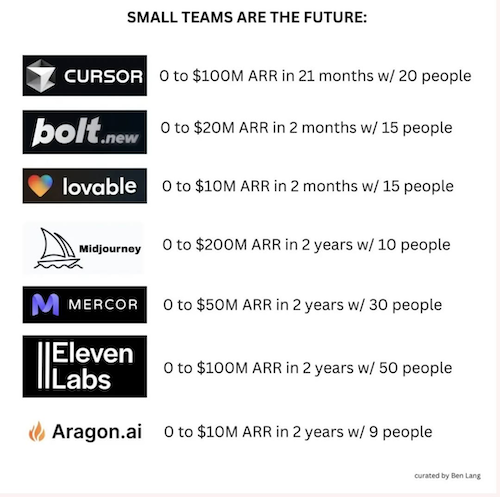
Cursor.ai, which recently stunned the industry, reached $100 million in annual recurring revenue (ARR) in just 21 months with a team of 20, and is now valued at $9 billion (roughly ₩13 trillion). Bolt.new and Lovable, each with a team of 15, posted $20 million and $10 million in ARR respectively in only two months. Midjourney, famous for its image generation AI, hit $200 million in ARR in two years with just 10 people. Mercor (30 people), ElevenLabs (50 people), and Aragon.ai (9 people) are putting up similar numbers.
These companies did not succeed because they got lucky, because they were exceptionally good at one particular thing, or because they locked down a patent nobody else had. They succeeded because their products outclass the competition on every dimension while continuing to hold or widen that gap. And their competitors are the famous global big tech firms — the ones with tens or hundreds of thousands of employees who write trillion-won investment checks without blinking!
I believe this kind of innovation is precisely the result of vibe coding. Vibe coding is a way of building software rapidly through natural language, making aggressive use of AI models. Used well, it lets a handful of people handle far more work, which dramatically cuts intra-team communication overhead while sustaining high productivity and quality.
At companies that have adopted vibe coding, developers can also get deeply involved in product design. As the development burden drops, a single person can take on the roles of multiple developers, a manager, and a product planner all at once.
The threat from AI is now real
Non-tech companies, meanwhile, are often unaware that a change of this magnitude has even arrived. The situation at tech companies isn’t dramatically different. Business Insider reported that around June 2024, AWS chief Matt Garman told employees that “there’s a chance most developers will not be coding 24 months from now.” I think that remark was far too complacent an optimism. By that point, Cursor was already spreading fast among developers by word of mouth.
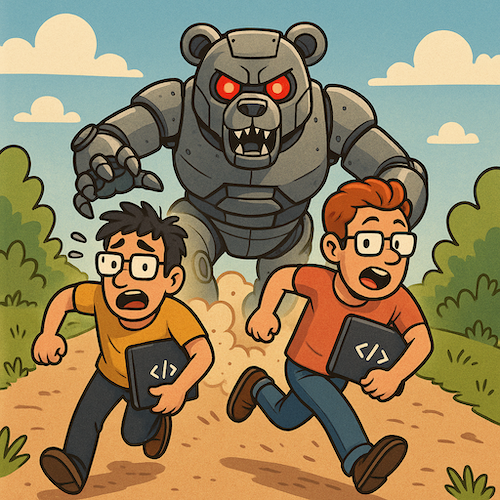
It isn’t only tech companies: every incumbent is about to face a serious threat from startups wielding vibe coding as a weapon. If you view AI as nothing more than a threat, the survival window for both companies and developers gets very short. If you liken the threat of AI to fleeing a predator, you might figure that you only need to run faster than the person next to you to avoid being eaten. But that is merely buying time — it does not change the fact that you are eventually going to be caught.
But what if you got on AI’s side instead? AI can be a tool that amplifies your own abilities — not just for developers, but in every role.
Vibe coding is no longer optional. It is an essential strategy for survival.